William Bell Scott was born in 1811 in Edinburgh and died in 1890 at Penkill Castle, near Girvan in Ayrshire.
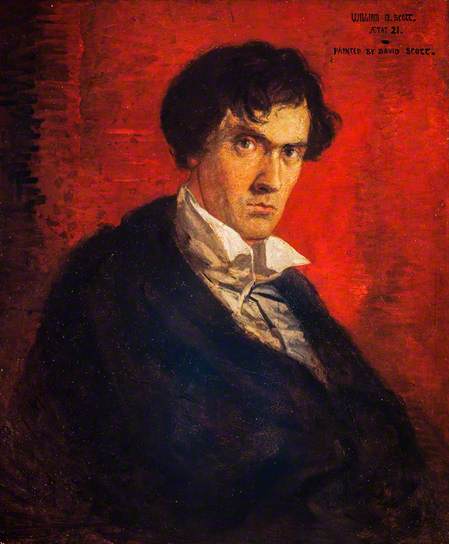
David Scott, William Bell Scott (1832). Credit: National Galleries of Scotland and The Public Catalogue Foundation.
Edinburgh. William Bell Scott’s father, Robert, was a successful engraver in Edinburgh. Scott entered the Trustees Academy, an art school in Edinburgh, in 1827, and studied there under Sir William Allan. Scott’s elder brother, David Scott, was also a painter, and his work in a Romantic grand manner had a significant influence on his brother. As a young man, William Bell Scott worked in his father’s engraving business. He greatly admired the second-generation Romantic poets Shelley and Keats, and began to write his own poetry, encouraged by John Wilson, who wrote for Blackwood’s Magazine under the pseudonym of Christopher North.
London. In 1837, at the age of 25, Scott moved to London. He supported himself mainly by engraving work, but continued to write poetry and aspired to become a historical painter. In 1838, he married Letitia Norquoy. Scott exhibited his first historical paintings in 1840, and achieved a measure of success in 1842 when his Chaucer painting was accepted by the Royal Academy. He entered the Westminister Hall competition in 1843 for historical designs to decorate the Houses of Parliament, but did not win a prize. Scott then accepted a position as headmaster of the newly established Government School of Design at Newcastle upon Tyne.
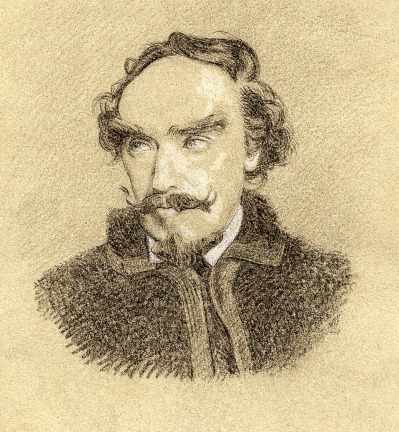
Print of William Bell Scott by unknown artist (circa 1850). Credit: Laing Art Gallery, K9040.
Newcastle. Scott spent twenty years in Newcastle. He lived first at 3 St. Thomas’ Street, and later around the corner at 14 St. Thomas’ Crescent. Through his position at the local art school, Scott became a leading citizen in the northeastern industrial city. He formed friendships with local industrialists and encouraged their patronage of the arts. The remarkable collection of James Leathart was influenced by Scott’s advice. He was also friends with Thomas Dixon, a working man from Sunderland best known for his correspondence with John Ruskin published as Time and Tide by Weare and Tyne (1867). Scott continued to exhibit paintings in London, and his paintings of King Arthur (1847) and William Wallace (1851) were accepted by the Royal Academy.
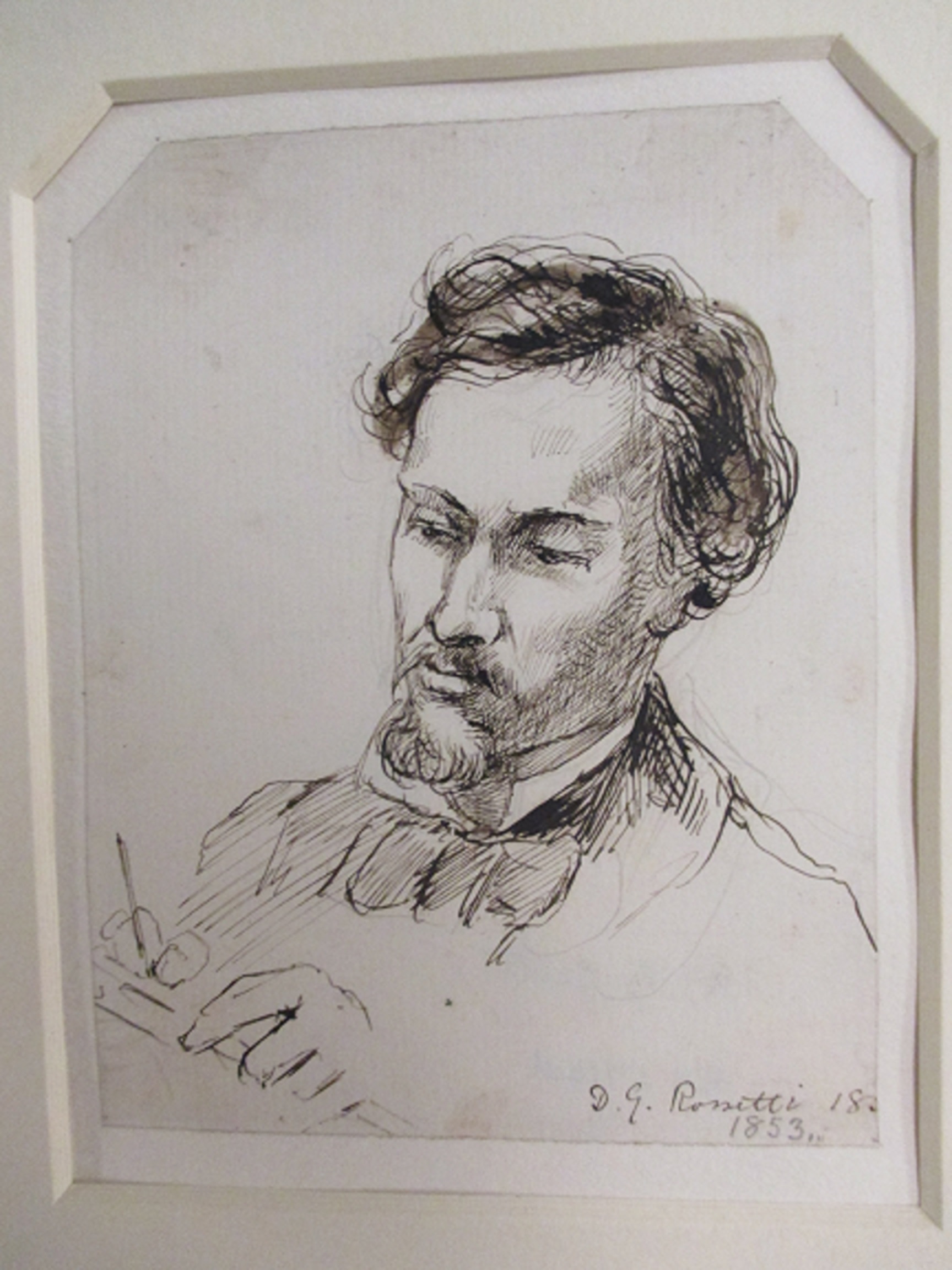
William Bell Scott, Dante Gabriel Rossetti (1853). Credit: National Galleries of Scotland, D 4714 D.
Dante Gabriel Rossetti. In 1847, Dante Gabriel Rossetti, then a 19-year-old art student, wrote to Scott. Rossetti had read Scott’s poems “Rosabell” and “A Dream of Love.” “So beautiful, so original did they appear to me,” Rossetti wrote, “that I assure you I could think of little else for several days . . . .” Thus began Scott’s life-long friendship with the Rossetti family, including Gabriel’s brother William Michael Rossetti and his sisters Christina and Maria Rossetti. While it is doubtful that Scott was romantically involved with Christina Rossetti, as Lona Mosk Packer conjectured, the two were close friends. Scott soon was exposed to the pre-Raphaelite paintings of Rossetti, William Holman Hunt and John Everett Millais, which had a life-altering effect on him. Scott began himself to paint in the pre-Raphaelite style. Some of his best works, such as Fair Rosamond Alone in Her Bower (1852), date from this period. Scott contributed to the pre-Raphaelite literary journal The Germ (1850), and in 1854 published Poems, which rightfully deserves credit as the first book of pre-Raphaelite poetry.
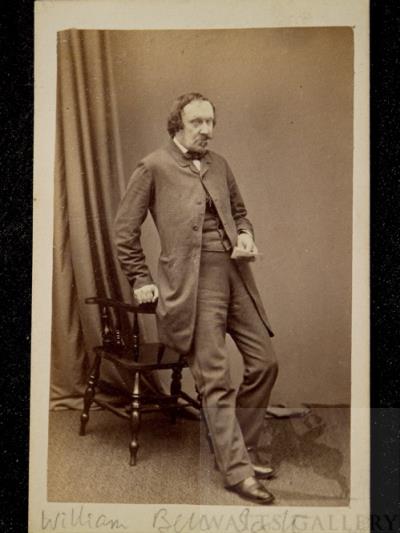
William Downey, Photograph of William Bell Scott (1858). Credit: Watts Gallery, Surrey.
Wallington. In 1855, Scott met Pauline, Lady Trevelyan, who presided over a vibrant intellectual circle at Wallington Hall in Northumberland. She and her husband, the temperance campaigner Walter Calverley Trevelyan, commissioned Scott to paint a series of eight pictures of Scottish-English border history (1856-61). These paintings, which are displayed today in the National Trust property at Wallington, are Scott’s most important works. Pauline Trevelyan was a disciple of John Ruskin, which caused some friction with Scott, who did not see eye to eye with the great cultural critic. Through Pauline Trevelyan, Scott became friendly with the young poet Algernon Swinburne.
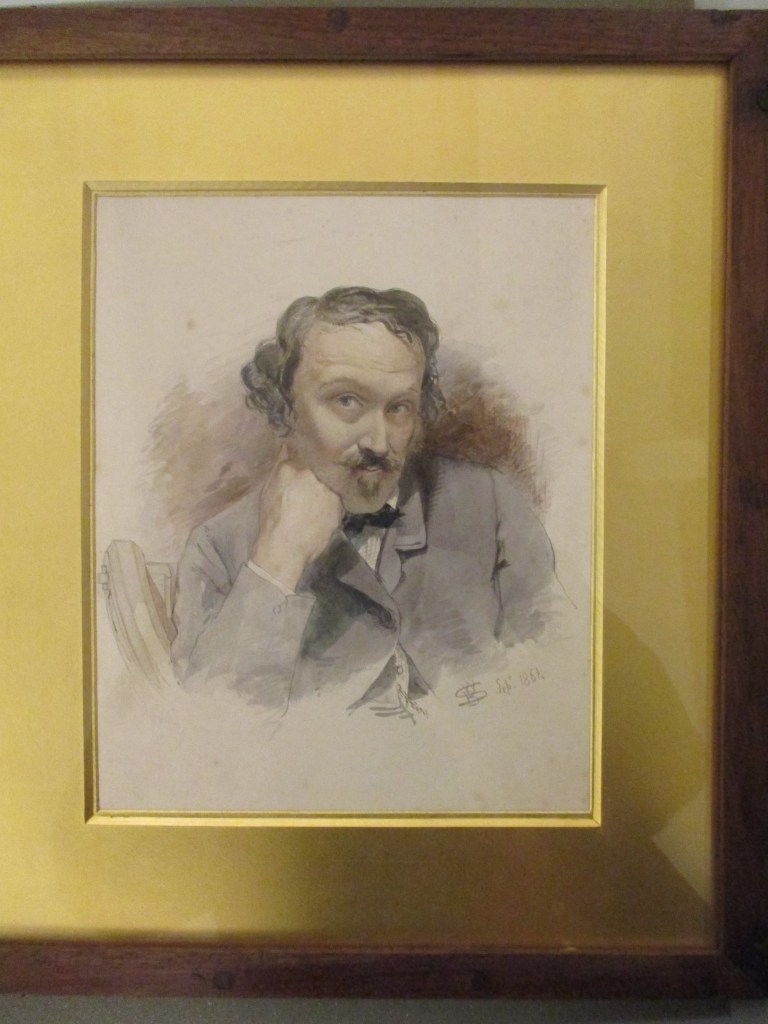
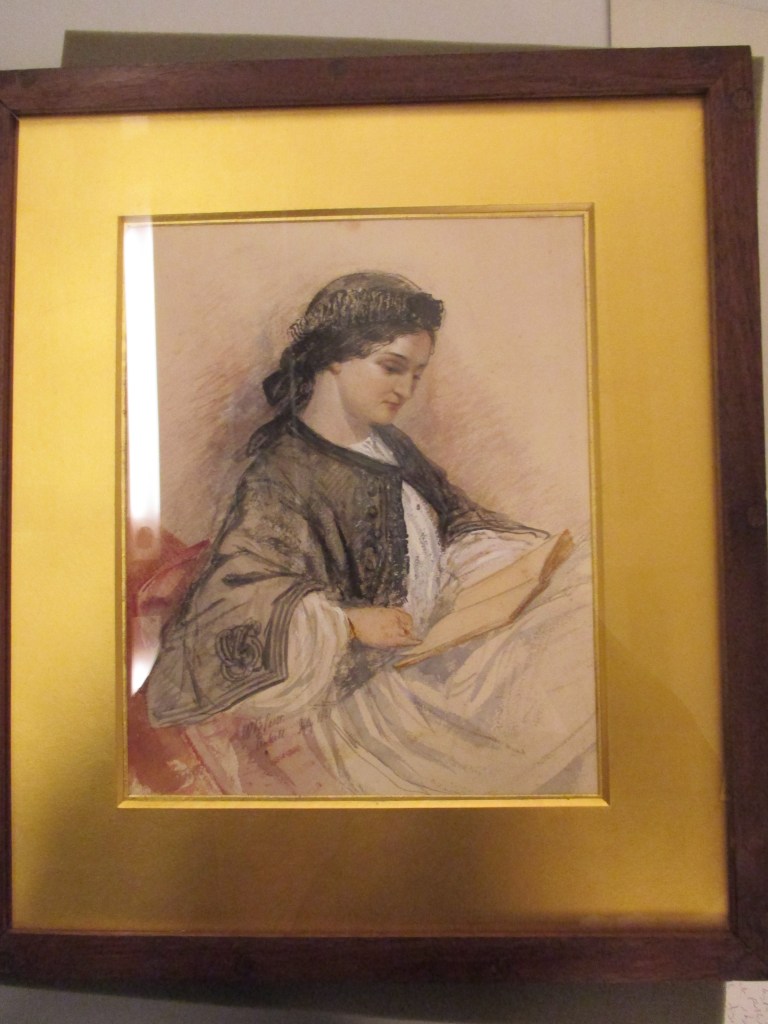
William Bell Scott, Self-Portrait and Portrait of Alice Boyd (1861). Credit: National Galleries of Scotland.
Alice Boyd. In 1859, Alice Boyd, a 35-year-old unmarried woman, took up drawing lessons with Scott. This led to a life-long romantic relationship. Boyd was the model for many of Scott’s paintings, including Una and the Lion (1860). She inspired Scott after many years’ focus on historical painting to take up landscapes again, and create some of the most interesting pre-Raphaelite landscapes. Boyd was also a painter in her own right.
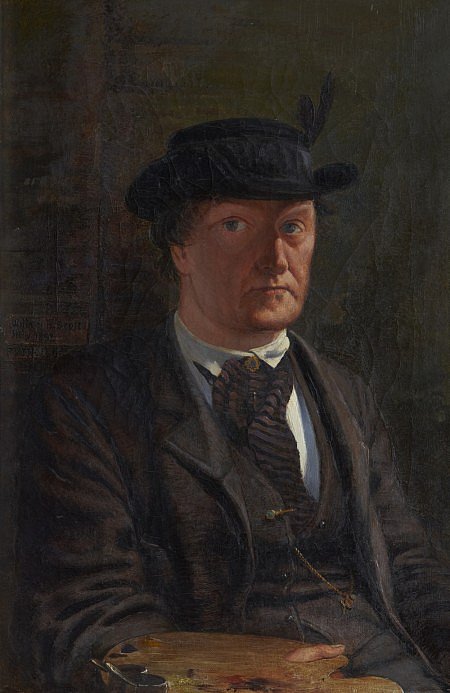
William Bell Scott, Self-Portrait (1867). Credit: National Galleries of Scotland.
Return to London. In 1864, Scott and his wife Letitia returned to London. Around this time, Scott had an attack of alopecia and lost all of his hair. The Scotts lived first in Notting Hill, and then at Bellevue House, 92 Cheyne Walk in Chelsea, near Dante Gabriel Rossetti. Over the next twenty years, Alice Boyd spent much of the year living with the Scotts in London, and she and Scott would spend the summer and early autumn at her castle at Penkill, in Scotland. Scott continued to paint, now in an Aesthetic style. William Bell and Letitia Scott presided over an intellectual salon that encouraged younger literary talents. The success of Scott’s biography of Albrecht Dürer (1869) led to a second career as an art critic. Scott served for a time as the art editor of The Academy, and was the author of a number of art books. In 1875, Scott published Poems, a collection of his best verse, some original and some reprinted.
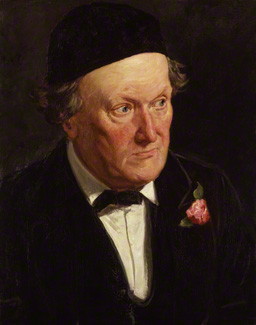
Frederick Bacon Barwell, William Bell Scott (1877). Credit: National Portrait Gallery.
Penkill. Penkill Castle, near Girvan in Ayrshire, is a sixteenth-century castle, restored in the nineteenth century by Alice Boyd’s brother Spencer. From 1865 to 1868, Scott painted one of his major works, a mural of The King’s Quair, the medieval poem by King James I of Scotland, in the stairwell of Penkill Castle. When Scott suffered an attack of angina in 1885, he came to stay at Penkill. For the last five years of his life, he was an invalid there, under Alice Boyd’s care. Scott received visitors and maintained a lively correspondence until his death in 1890.
Posthumous reputation. Scott is best known today for his memoirs, the Autobiographical Notes, which were published in two volumes in 1892. Scott presented an unvarnished picture of Dante Gabriel Rossetti and his other friends. While criticized by contemporaries for their frankness, Scott’s memoirs today are recognized as an important historical source.
Bibliography. For a list of selected works on the life of William Bell Scott, see here.
The text of this website is copyright © Antony Ryan 2019, 2026.
 William Bell Scott